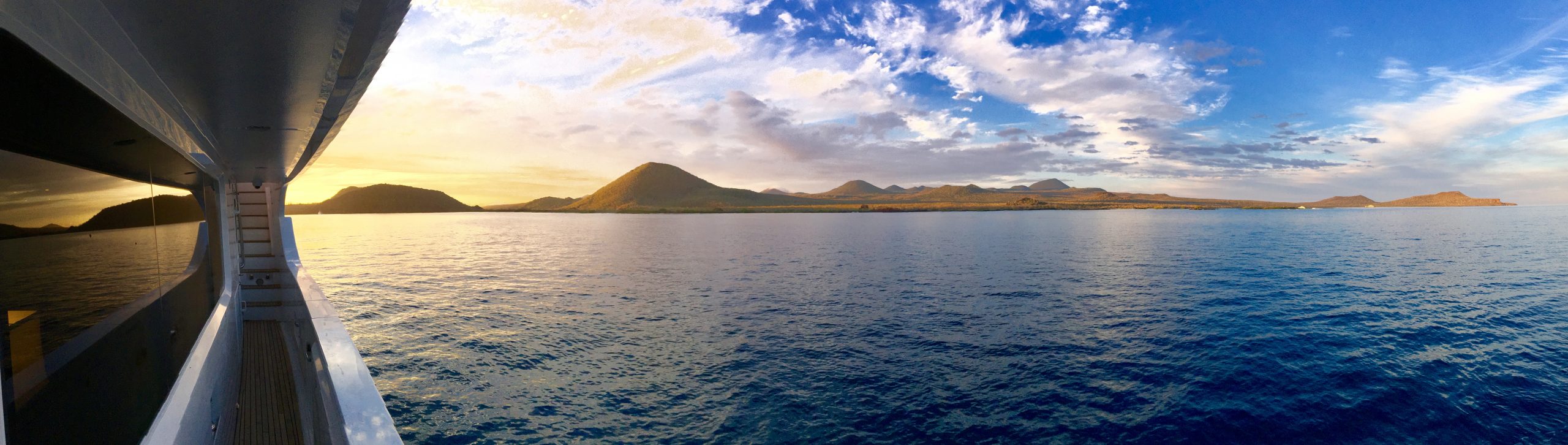
Any boat entering the Galapagos has to be inspected to insure nothing is brought in that could hurt the ecosystem. We had various government agencies aboard Warbird that conducted full inspections. We also had to have a diver inspect the bottom of the boat for barnacle growth. Luckily none was found. If they did find any growth the boat would have to go 45 miles out to sea to scrub the bottom. Warbird passed all inspections with flying colors!
I’m not sure if they are inspecting or snoozing!

Fridge inspection!

Here is a video of our crossing of the Equator!
San Cristobal, Galapagos

Our new BFF!

Warbird on the hook in Cristobal harbor.

We are entering our third evening since we departed from Panama for the Galapagos Islands. The trip has been calm and quiet and the boat is running perfectly. The crew took advantage of the great weather and spent the day prepping for our arrival into the islands.
We are exactly halfway through with 425 NM to go. The current has been in our favor which will help us arrive 24 hours ahead of schedule. Out internet us dropped off a bit. As I mentioned in a previous post, I expect our internet connection to blackout in the next day or so. Once we get to the Galapagos we will be back in cell range and continue posting. It has become difficult to post in the last 24 hours , especially pics and videos. Overall the crew is in high sprits and looking forward to arriving at our destination. So far everything we have posted in the blog since the beginning has been about getting there! The real fun will begin on the other end, stay tuned!!!
By Captain John
Today we had an interesting encounter that was a bit out of the norm. It was mid afternoon and I had just settled into the comfy pilothouse Stidd chair to begin my watch. It was a beautiful day out on the water. We had calm winds, flat seas, and not a cloud in the sky. I didn’t expect much activity on the radar due to the fact the closest point of land was the coast of Columbia, 275 NM southeast of our current position. While scanning the horizon, next thing I know I have a small vessel directly off our bow at a range of a mile or so. My initial reaction was surprise, how can a small vessel be out this far from land? It appeared the vessel was drifting and disabled, with two person waving their arms in the air.
Now at this point as Captain, many different scenarios began to play out in my mind at the same time. Are we going to have to bring these persons aboard warbird? Will they need a tow back to port? Are they hurt? As these thoughts race through my mind, the vessel out of nowhere starts its engines and is underway heading towards us. This immediately put me into a defensive mode. Why would a disabled vessel all of a sudden start heading right for us???
We had limited time, but mustered the crew and made a game plan. We decided when the vessel approached the crew would stay inside except for Captain Bob, (fluent in Spanish) who would confront the men. If things took a turn for the worst we would fire the flare gun and perform defensive maneuvering of “Warbird.” Armed with a flare gun, “Cowboy Bob” stood by on bridge wing as they pulled alongside our bow. I can now see this is a 30ft completely open cockpit panga style boat. Two men were onboard surrounded by large crates covered in black plastic. Nothing else was in the boat. The boat was old, but had two brand new large Yamaha outboards.
Bob was friendly but stern when he greeted the vessel. He made a point to show he was armed with a flare gun, but not in an aggressive manner. The men immediately got the hint and had their hands in the air. Captain Bob began to question them on their intentions and overall situation. He learned they we lost at sea because the hand held GPS they were using for navigation had dead batteries. They were trying to find the coast of Columbia, and they were out of food and water. There is really no other reason for them to be out here except for running drugs. We figured they made a drop of in Coast Rica and are now returning. Keep in mild we are almost 300 miles offshore!
Bob kept an eye on the men as I manned the helm. The crew put together a bag with some food, drinks, and batteries. Once the transfer of these items was complete, the men thanked us and asked us to point them in the direction of the Columbian coast. They then turned around, waved good-bye, and motored off into the abyss. This boat did not have fishing gear, or anything else aboard that would explain how they ended up there. I can’t imagine how long it took them to get back to the coast, or if they even made it. After it was all over and the crew stood down I began replaying the events in my head. There were many different ways this could have ended up. The way it did was best case. I found it interesting how I immediately assumed they were potential Pirates and went into a defensive mode. As much as I would like to help anybody that might be in distress, my responsibility lies with my ship and crew. In this situation something didn’t feel right, but the situation ended up OK because we kept our cool. We will never know the real reason these men where so far from land, or if they made it back. We can only wonder.
Over the years I have learned every day is a new adventure out on the water and today was no different I am glad to put the “Pirates” behind us and open sea ahead!

This morning before our departure from Panama we filled up the fuel tanks aboard Warbird to the top. On paper, the boat can hold 6800 gallons of diesel fuel. Today will filled up to just shy of 6700 gallons. Normally we don’t have a need to fill the tanks all the way to the top. With our low fuel consumption it usually isn’t nessesary. Due to the nature of the Galapagos trip we wanted to get as much fuel aboard as possible. This is because we want to avoid the need to fuel in the Islands. They do have fuel available, but it is quite expensive and a hassle to bring aboard. We will plan to make the trip to the Islands, complete a two week cruise, then make the trip back and refuel upon our return to Panama. During this time we will cover over 2500 Nautical miles. We will also be running our generators 24 hours a day for the next 5 weeks. The generators can burn up to 48 gallons per day under heavy load. Overall we should have plenty of fuel to complete this trip. I anticipate that we should still have over 2000 gallons remaining in the tanks when we return to Panama. We are currently cruising at 900 RPM and making 7.5 kts. Fuel burn per hour is 7 gallons total! Not Bad!
Fuel barge in Panama!

Ricky manning the fuel hose.

Panama is in the rear view mirror..
Before the start on any of our long ocean legs we will spend a few hours checking all systems aboard and prepping the boat. The following are just some of the checks we performed at Flamenco Marina today in anticipation of our departure tomorrow morning.
Ricky is checking the crane, anchors, tenders, and other gear on the bow for proper tie down and stowage. The tenders will be covered for the trip.

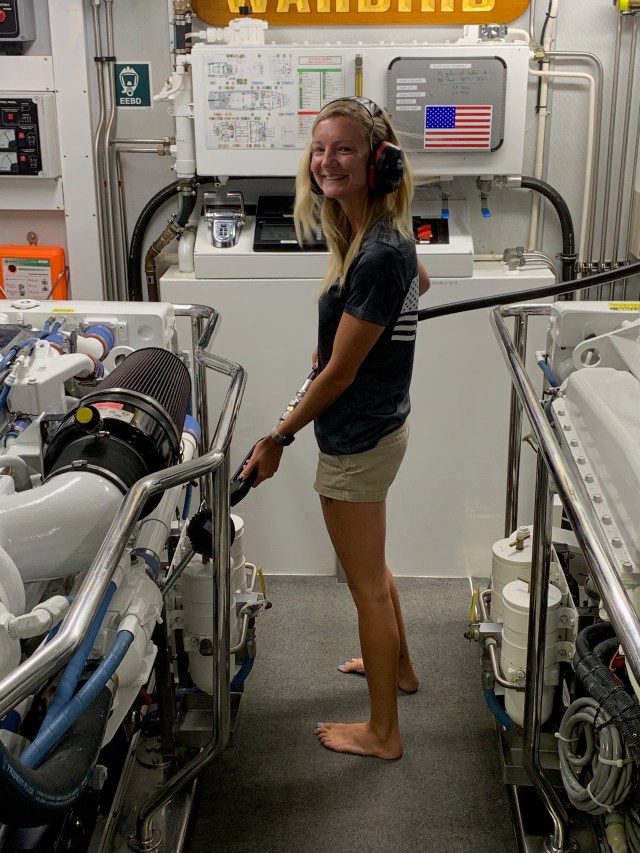
Taylor is helping with engine oil changes. All oil is transferred in and out of the engines by a series of pumps. No need to get our hands dirty! Right Taylor?
This is the shaft seal where the propeller shaft exits the hull. We inspect and clean this before each trip. The black hoses bring seawater from the engines to cool the shaft.

This is one of our two stabilizers. These are fins that are under the boat that move in tandem to keep us stable in heavy seas. We inspect them for leaks and check the tightness of all hose connections.

Pictured here is the main hydraulic tank and cooling heat exchangers. This system supplies hydraulic power to operate the stabilizers and thrusters. You will see two heat exchangers. We just added the one behind the yellow valves to increase our cooling capacity in warmer waters.

This is the main sea water supply aboard “warbird.” Most of our equipment uses seas water for cooling. All of this water enters the boat through five separate strainers that filter out any debris. These strainers must be checked and cleaned before each trip.

This is our fuel and oil transfer manifold. This is how we transfer fuel and oil for oil changes and fuel tank adjustments. We must confirm all valves are in the proper position.

We have two water makers aboard “Warbird.” These will produce fresh water from seawater through reverse osmosis. We can make up to 3000 gallons a day to keep our tanks full on a daily basis. Before a trip we will change filters and flush membranes to make sure they are ready to go!

This is one of our two diesel generators. They produce our power when away from the dock. They are both 40KW generators that output 208 volt 3 phase power. The boat only needs one at any given time. They are on automatic timers that rotate them every 24 hours while at sea. Before a trip we conduct inspections in make sure they are ready to run.

This is our steering system. One of the may systems that gets a visual inspection with all fitting tightened before a trip.

This last picture is the waste treatment system. This system takes all of our black and grey water (sewage) and “treats” it before it is pumped overboard. The system must be flushed and inspected on a weekly basis.

After a few requests, I thought it would be fun to devote a portion of the bog to the extensive equipment and machinery found aboard “Warbird.” We will begin with basics like engines and generators. We will then dive into the additional layers of technical redundancy that separate “Warbird” from most regular coastal cruising yachts. I will explain the features that allow us to cross great distances of open ocean in unfavorable conditions in relative comfort and safety.